Home » Travel Information » Facts About Chimpanzees, Chimpanzee Facts
Facts About Chimpanzees, Chimpanzee Facts
Fun facts about Chimpanzees! Chimpanzees (Pan troglodytes) are incredible apes that belong to one family as humans- the Hominidae. To many, Chimpanzees are simply called Chimps.
Amazingly, chimps are believed to share over 98-99% of man’s DNA therefore, they are considered the closest cousins of man. Globally, the endangered Chimpanzees only live in Africa, mainly in central and western Africa.
Although there are many Chimpanzee interesting facts, this blog has brought you the main Chimpanzee facts you should know!
The best way to explore much about Chimpanzee facts is to track chimpanzees on your safari in Africa. We recommend Uganda chimpanzee safaris in Kibale National Park for the best experience with chimps- amazing cousins of man!
Below are the various facts about Chimpanzees:
Quick Chimpanzee Facts
- Phylum: Chordata
- Family name: Hominidae
- Classification: Mammal
- IUCN status: Endangered
- Lifespan: About 45 years in the wild
- Weight: 32-60kg
- Height: 1-1.7m when standing upright
- Diet: Omnivorous
- Habitat: Tropical rainforests and woodland savannahs
- Range: East and West African countries
Classification of Chimpanzees
Chimps are categorized under four great apes, and these include the Gorillas, Bonobos- (Dwarf or Pygmy Chimpanzees), Orangutans (commonly known as the man of the forest), as well as Chimpanzees.
All the above great apes are closely related to humans however, according to science, Chimps and Bonobos are the closest human cousins.
Chimpanzees share about 98-99% of our DNA!
Physical Appearance of Chimpanzees – What Do Chimps Look Like?
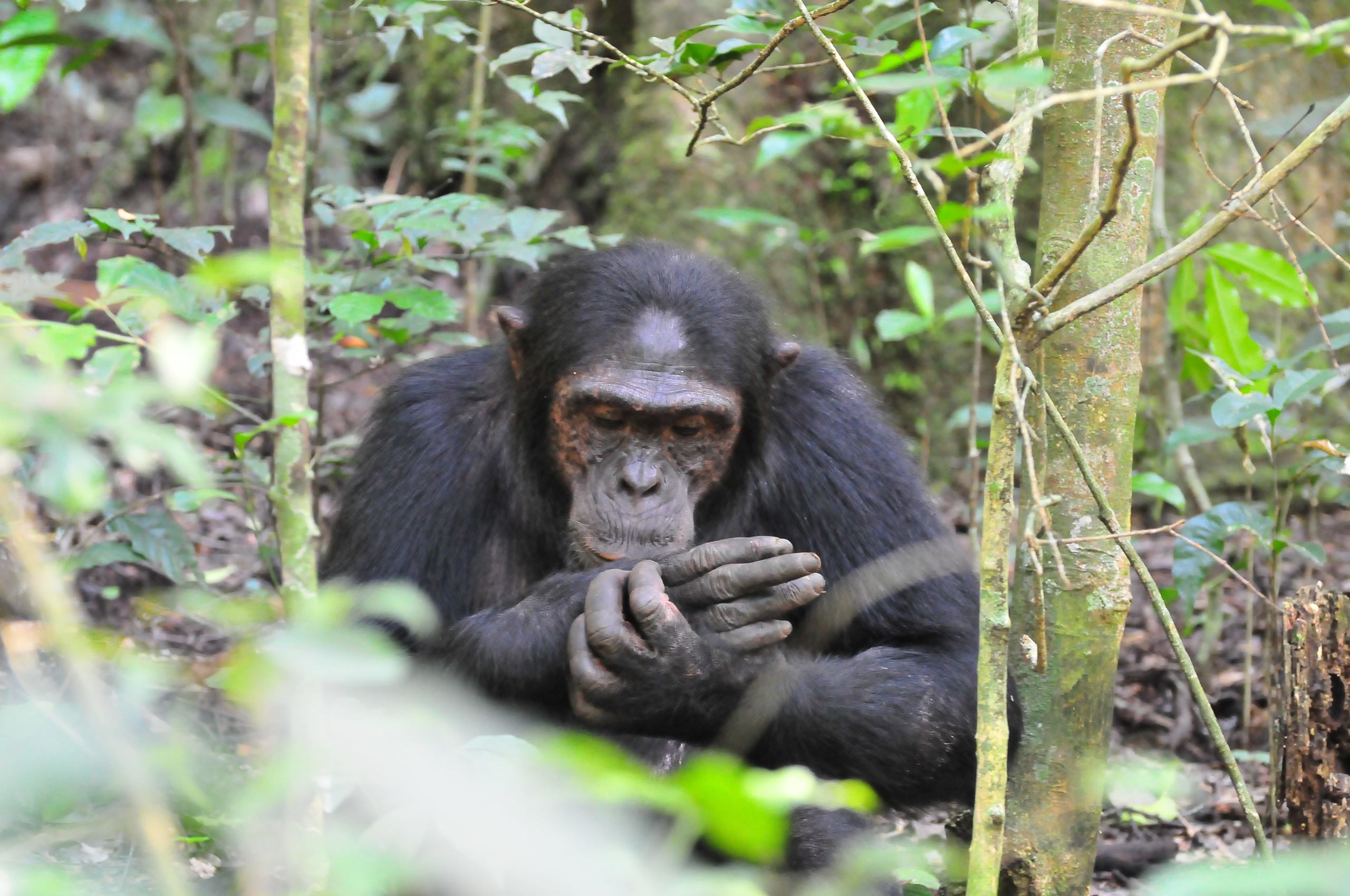
When standing, chimps are about 1 to 1.7m tall and have longer arms compared to their legs. This helps them to swing in trees from branch to branch. Just like humans, chimps have opposable hands!
The intelligent apes are covered in covered in coarse black hair, but their face, fingers, toes, and palms of the hands, plus the soles of the feet are bare.
Male chimps on average can weigh about 40-70kg while females 27-50kg. Chimpanzees are bigger than Bonobos.
Chimpanzee Diet- What Do Chimpanzees Eat?
Chimpanzees are omnivorous; however, they tend to eat fruits mostly than any other food. Fruits make up over 64.5% diet for chimpanzees in the wild and normally enjoy the ripe ones.
Other diets for chimps include leaf buds, flowers, leaves, stems, bark, seeds, pith, as well as gum. Honey, soil, as well as insects like termites and weaver ants are eaten.
Do Chimpanzees eat meat? Although it’s rare, Chimps diet can also include birds, eggs, as well as small mammals especially, primates. Juvenile Yellow baboons, Bushbabies, Red Colobus Monkeys, Blue Duikers, and Warthogs can be hunted.
Meat makes up about 2% of the Chimps diet in the wild.
Chimpanzee Behavior, Social Life of Chimpanzees
Chimpanzees live in communities of about 20-150 individuals (led by a dominant Alpha male). Individuals may form small temporary groups to feed, hunt, and patrol within their territory. The small group can consist of all males, adult females, and offsprings as well as adults of both sexes.
Please note that although Chimpanzees may split into smaller groups, they know each other! They can get together to defend their common locality.
In most cases, males remain in their natal communities but, females emigrate upon reaching adolescence. Therefore, males in a group are more likely to be related to each other.
Males yield more power in the group. These males share the responsibility of protecting the group, searching for food & patrolling the territory.
NB: Chimps build a nest in a new location every night.
Intelligence of Chimpanzees – How Intelligent Are Chimpanzees Compared to Humans?
Do you know that Chimpanzees share 98.9% DNA with humans? After humans, Chimpanzees are considered the most intelligent apes in the world as they are capable of using several tools for different purposes just like humans do.
Here is how intelligent are chimps:
- Chimps have been observed modifying rocks, leaves, and sticks to get termites out of their mounds or use them to spear other animals especially, the Bushbabies.
- More still, Chimpanzees have been observed opening hard nuts using stones and soaking up water to drink using leaf sponges.
- Besides using tools, chimpanzees reveal other signs of intelligence, for instance, the ability to remember symbols, as well as cooperating while doing tasks like hunting.
- Chimpanzees have self-awareness and are among the few pets known to pass the mirror test!
- Unlike most mammals, Chimps can laugh, tickle each other, and care for a dying member of the group.
All the above shows how intelligent chimps are, they are almost compared to humans!
Chimpanzee Communication – How Do Chimpanzees Communicate With Each Other?

Chimpanzees can communicate with each other, and this is done using several facial expressions, postures, as well as different sounds. For instance, a petrified Chimpanzee will display a special grin to alert others!
Chimpanzees can extend a hand, sneer, crunch, and swagger to send a special message. Also, they can drum or beat tree trunks, and this is normally done in case they encounter another community or a predator like a leopard.
More still, note that chimps have different vocalization! Hooting, grunting, and barking are used for bonding, greeting, and while feeding.
The most amazing part of chimpanzee trekking in comparison with gorilla tours is that chimps are very vocal. Their loud amazing calls and commotion make this adventure a memorable safari experience.
Travelers can hear chimps even before locating them.
Chimpanzee Reproduction
Chimps can mate all year round; however, females usually reach their oestrus circle in the season when food is readily available.
When a female chimpanzee is on heat or reaches sexual maturity, its anogenital region swells and gets a pink color. This signifies to the males that she is ready to mate. Usually, this female mates with several males in the community therefore, the father is not known.
The gestation period for Chimpanzees is about 8 months and usually, one baby is born. Offsprings can be born any time of the year. Mother Chimpanzee will take care of the offspring, carrying it at its back while walking.
A female chimp has a great time to be the best mother. She will teach her infant all the required skills to survive while in the jungle and protect it from other members of the community. It also offers emotional support!
Chimps get independent at the age of 4 years. Males reach sexual maturity at the age of 10 years while females at 12 years.
Chimpanzee Life Span – How Long Do Chimps Live in Wild?
How long does a Chimpanzee live? Chimpanzees in the wild can live about 15-30 years and on rare occasions, some may go up to 25-60 years according to the IUCN.
Note: The average life span for chimpanzees in the wild is shorter than those in captivity. On average, male Chimps in captivity can live 31.7 years while females 38.7 years for example, Little Mama- the oldest chimpanzee on Earth died in her 70s.
The biggest threat to the life span of Chimps in the wild is much affected by humans!
Aggression and Attacks of Chimpanzees – Are Chimpanzees Dangerous?
Chimpanzees are more aggressive than Mountain gorillas. Often, male chimps can gang up and take a deadly attack on other Chimpanzee communities and all this intends to establish dominance. These brutal fights can result in the death of some individuals.
On rare occasions, chimps are also known to attack communities for humans especially those living around their territories. In most cases, chimps target young children, and they can kidnap human babies!
In areas where chimps share territories with Gorillas, it’s possible to see them feeding in one tree. They hardly compete for food, instead, they ignore each other. Nevertheless, given the violent nature of chimpanzees, they have been seen trying to attack a gorilla family.
Chimpanzee Conservation Status
Chimps are listed among the endangered species on Earth according to the International Union for the Conservation of Nature (IUCN). Globally, only about 300,000 Chimpanzees in the wild are said to be living on Earth and are found only in tropical rainforests of Africa.
The biggest threats to Chimps are humans and this is in the form of habitat loss, diseases, and poaching. Normally, poachers are interested in meat as well as satisfying the demands of pet traders or Circus organizations.
Natural predators for chimps are leopards, and Lions however, these are very rare!
Organizations such as the African Wildlife Foundation (AWF), Worldwide Fund for Nature (WWF), and Jane Goodall Institute are working tirelessly to protect chimps in Africa.
The Worldwide Fund for Nature helps to monitor Chimpanzee population in several parks. It further encourages local communities around chimpanzee parks to sustain forests where chimps live.
In Uganda, Chimpanzee population has increased over time, and currently, Uganda chimpanzee trekking tours are regarded as the best in Africa.
Gombe National Park in Tanzania is the 1st park gazetted to conserve Chimpanzees. All these were efforts of the great primatologist and anthropologist Jane Goodall.
More FAQs About Chimpanzees
What Is the Scientific Name of Chimpanzee?
The scientific name of chimpanzees is Pan troglodytes. Chimps have 98-99% DNA similar to that of humans.
Where Are Chimpanzees Found?
In the whole world, Chimpanzees can only be found in Africa! Mostly, they live in tropical rainforest belts within southern Senegal, north of Congo River, western Uganda as well as in western Tanzania.
If interested in chimpanzee tours on your African safari, consider undertaking Uganda Chimpanzee tours.
Why Are Chimpanzees Endangered?
The International Union for the Conservation of Nature (IUCN) declared chimps among the endangered species on Earth as their population was getting into extinction. However, due to the great effort of several conservation organizations like the Worldwide Fund for Nature, their population has gradually increased and is now promising.
How Many Chimpanzees Are Left in the World?
About 170,000 to 300,000 Chimpanzees in the wild are estimated to live on Earth. Chimps in the wild can only be found in Africa within 21 countries. Among these, we recommend chimpanzee trekking in Uganda tours to offer the best experience for track chimpanzees in Africa.
Are Chimpanzees Friendly to Humans? | Are Chimpanzees Aggressive Towards Humans?
Often, wild Chimpanzees are fearful of humans and will always keep a distance! However, there have been some incidents of chimps attacking and killing people especially, those that live close to chimp territories. Young children (babies) may fall victim!
Out of sheer curiosity, a chimp might pick up a small child as if it were grabbing a toy.
Are Chimps More Aggressive Than Gorillas?
Although Gorillas are more powerful than Chimpanzees, they are considered more peaceful than Chimps. In fact, Gorillas are referred to as the cool giants of the forest.
What is Stronger a Gorilla or Chimpanzee?
Gorillas are incredibly far stronger than Chimpanzees. Realistically, a Gorilla is about 4-6 times stronger than a chimp. These fights are quite rare, and they have been recorded living harmoniously.
How Strong Is a Chimpanzee? | How Strong Are Chimps? | Are chimps stronger than humans?
Most people exaggerate Chimpanzee strength saying it’s 4-5 times stronger than that of humans however, this is not true! Studies show that chimps are about 1.2 to 1.5 times stronger than the most powerful man on Earth.
Chimps being stronger than humans is due to their having faster twitching muscle fibers than men.
Chimpanzee Laughing – Do Chimpanzees Laugh?
The flanking expression Chimpanzees have to a smile is the play face. While a Chimp is enjoying a good tickle session with one another, it might show its bottom row of teeth with its mouth open and relaxed. This can be even accompanied by laughter- one of the best sounds on Earth in my view!
Do chimps smile? Most people misinterpret this facial expression of chimps. Normally, a chimp smile signifies fear!
Chimpanzees Locomotion – How Do Chimpanzees Walk?
Chimps are adapted to both terrestrial and arboreal locomotion. The arboreal locomotion involves vertical climbing as well as brachiation and swinging from one tree branch to another. Chimp hands have higher fast twitching muscles that enable them to easily climb and swing in trees.
Terrestrial locomotion involves Chimps walking on the ground. This can be done either quadrupedally (knuckle-walking) or bipedally (on two legs). They rarely move on two legs!
Chimpanzee Interesting Facts – What Is Special About a Chimpanzee?
There are several amazing facts about Chimpanzees worth knowing for every traveler intending to go chimp trekking in Africa.
Here are the most interesting facts about Chimpanzees you should know:
- Chimps have 98-99% DNA similar to that of humans.
- Globally, wild chimps only live in Africa- within 21 countries only.
- Chimpanzees are omnivorous-
- Just like humans, chimps have a complex family structure and live in communities.
- Chimps don’t smile! This expression simply means that it’s frightened.
- Just like humans, Chimps can modify tools.
- Chimpanzees are endangered species.
I guess you have enjoyed our interesting facts about Chimpanzees- amazing man’s closet cousins living in the wild! The best alternative to explore more fun facts about Chimpanzees is either to undertake a chimp trek or Chimpanzee Habituation Experience.
Uganda chimpanzee safaris in Kibale National Park offer the best chimp trekking experience in Africa.
For The Best Chimpanzee Trekking Safaris in Africa, Contact Us Today!
What you may like
-
Chimpanzee Trekking Rules and Guidelines in Kibale National Park
READ MORE -
Best Time For Chimpanzee Trekking in Uganda Kibale National Park- When to Track Chimpanzees in Africa?
READ MORE -
Visit Uganda: Visiting Uganda – Visit to Uganda
READ MORE -
Best Time To Visit Uganda – When is The Best Time To Visit Uganda?
READ MORE -
Geography of Kibale National Park | Kibale Forest Park Geography
READ MORE -
Kibale National Park Entrance Fees
READ MORE
Want to visit Kibale Forest?
Want to visit Kibale Forest National Park, Uganda's best chimpanzee trekking destination?
